- Rank A — it holds up in Division 1.
- Two CFs and two AMFs pull them into the middle; the full-back goes past them and crosses.
- One holding midfielder means you cannot force your way through the centre. Play the flanks.
The 5-1-2-2 is a 4-2-2-2 with five at the back. You keep the two CFs and two AMFs that make that shape dangerous, and you fix the thing it struggles with — being countered — by adding a defender. What you give up is the second holding midfielder: with only one, going through the middle yourself is hard, so the goals come from the flanks.
5-1-2-2: overview
| Rank | AWorks in Division 1 |
|---|---|
| In one line | Pull them into the middle, then hit them down the side — a back five that still attacks with four |
| Biggest weapon | Almost impossible to catch on the break: five at the back absorbs central attacks |
| Biggest weakness | One holding midfielder, so you cannot break teams down through the middle |
| Suits you if | You like the two-CF, two-AMF attack but want to defend properly |
| Not for you if | You want to play through the centre |
| Team Playstyle | Quick Counter / Long Ball Counter |
Rank A means it works in Division 1. Our ranks come from the Division a formation actually holds up in — this one won four and lost one of five games in Division 1, scoring 11 and conceding six.
What it does well, and where it hurts
- Two CFs, two AMFs and a full-back getting forward gives you real numbers in the attack for a shape with five defenders.
- Unlike a 4-2-2-2, five at the back makes you almost impossible to catch on the break — that is the whole reason to play this instead.
- With that many defenders, keeping the ball at the back is comfortable and you are rarely pressed into a mistake.
- One holding midfielder makes it hard to move the ball forward through the centre, which is where your four attackers are.
- The middle gets crowded, so the attack ends up depending on the flanks.
- The one route through the centre is the build-up route, not a way to score — so almost every goal has to come from the flank.
The shape
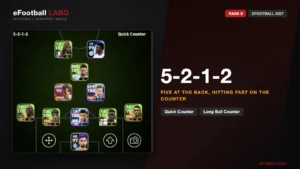
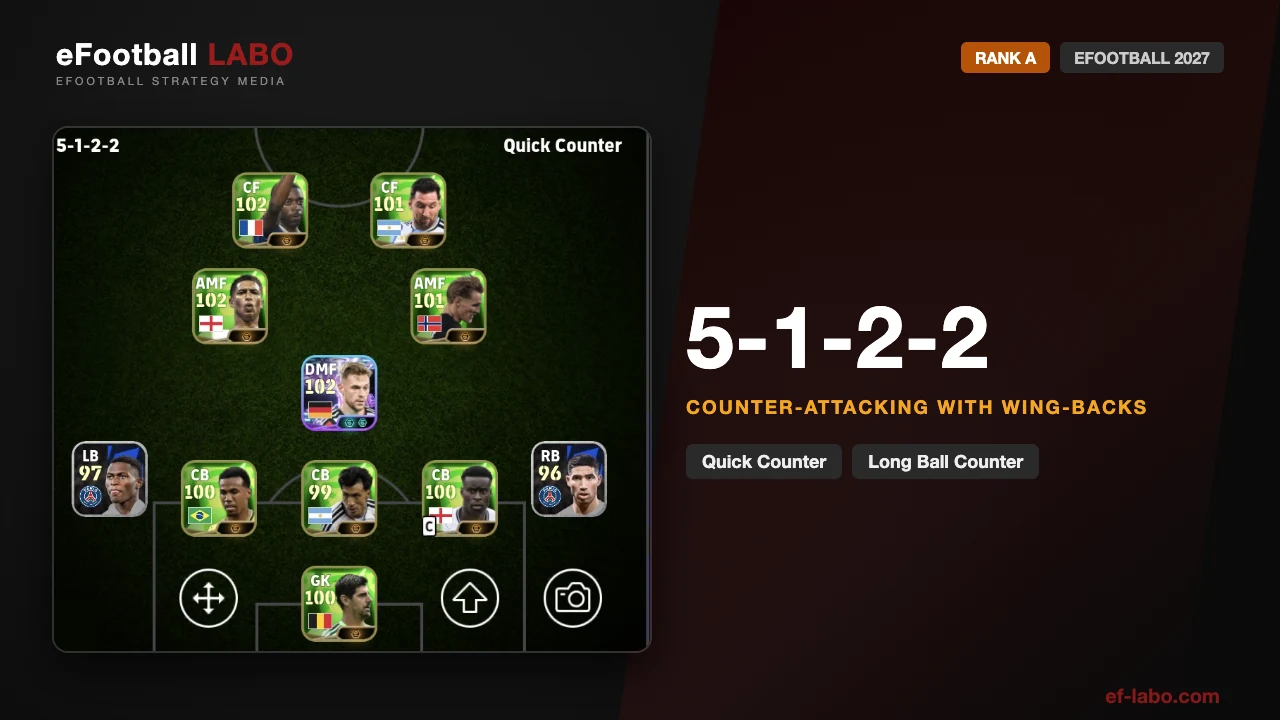
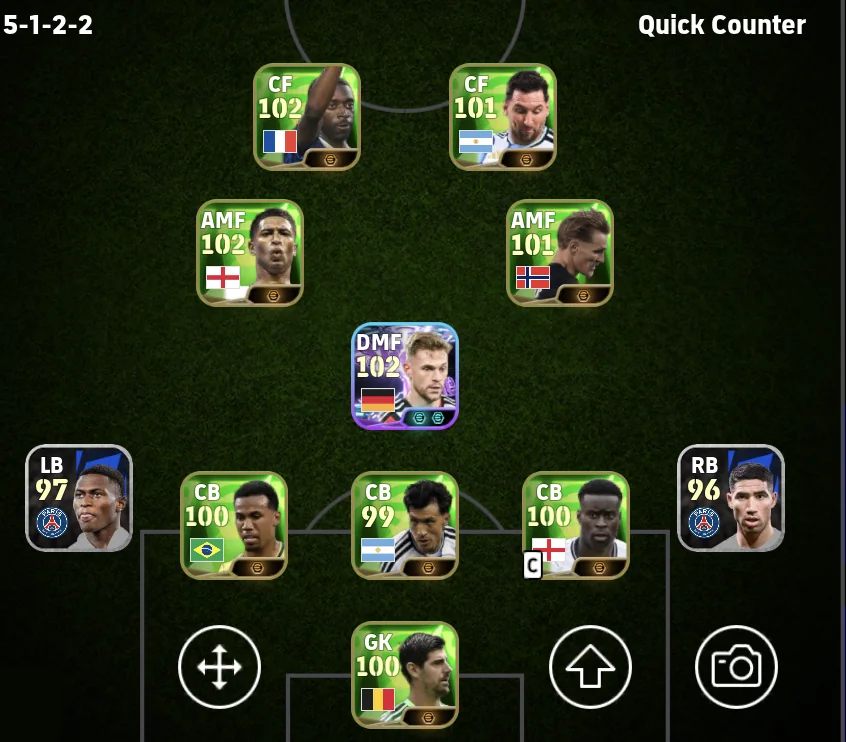
5-1-2-2: three CBs and two full-backs, one DMF, two AMFs and two CFs.
Three CBs and two full-backs, one DMF at the base, two AMFs ahead of that player and two CFs. It is the front four of a 4-2-2-2 with an extra defender behind — you trade the second holding midfielder for a fifth at the back.
How to attack
Pull them into the middle, then go round them. Two CFs and two AMFs standing close together is a problem their defence has to answer, and answering it leaves the flank open. That is where the full-back arrives, from either side. There is a second way in off the same setup: instead of the full-back going outside, an AMF runs into the half-space between their full-back and their CB, takes the through ball and cuts it back.
Out Wide: pull them in, then go down the side
The move the shape is built on. The forwards and AMFs give them something to worry about in the middle; the space that opens is out wide. It works the same from either side — the diagram shows the right.
- A CF lays it off to an AMF, which pulls them into the middle
- The RB pushes on down the right
- That AMF switches it out to the RB
- The RB gets down the right and pulls a low cross back
- The other CF meets it and finishes
Building up
Numbers at the back make keeping the ball easy; one holding midfielder makes getting it forward hard. Those two facts define the shape. The central route runs through a single player, so when they shut it, go out to a full-back and start again rather than forcing a pass into the crowd.
Through the middle, as far as it goes
Three passes and you are in their half. It works when they leave the middle alone — and the moment they do not, the same three passes stop working.
- A CB finds the DMF
- The DMF plays it into an AMF who can turn
- That AMF plays a vertical pass into a CF
Mistakes people make, and the fix
Your defence keeps dropping and you concede
| Why it happens | What to do |
|---|---|
| Someone carries the ball into the space between the DMF and the CBs. With one holding midfielder there is no second player to get across, so if that one cannot reach it, the whole line retreats and you get beaten by a shot from distance or a ball over the top. | Send a CB out to close them down rather than dropping deeper. Five at the back means you can spare one — and here you have to, because there is no second midfielder to do it. |
You lose it passing along your own back line
| Why it happens | What to do |
|---|---|
| Keeping it at the back is comfortable, which is exactly why people get careless. Every vertical ball goes through one player, so their press only has to read one pass. | If they are closing you down, go out to a full-back or back to the keeper. The pass into the DMF goes in once they have committed, not before. |
How to defend with it
This is the strong half of the shape. Five at the back plus a holding midfielder makes the middle very hard to play through, which is exactly what a 4-2-2-2 struggles to do.
| Area | What to do |
|---|---|
| Midfield | One holding midfielder, so position beats pressure here. Take control of that player, cut the pass into their forward, and do not dive in — leaving the middle is what a 4-2-2-2 can afford and you cannot. |
| Wide | The full-back and the CB on that side defend it together, and because your attack needs that full-back forward, this pairing comes up every game. Three CBs behind means one can always cover. |
| Back line | Five at the back is the whole reason to play this instead of a 4-2-2-2. Use the spare defender: step out and win it instead of sitting off. |
| When ahead | Set the DMF to Defensive in Individual Instructions. That tightens the middle further and lets the back five see it out — no change of shape needed. |
Players and playing styles that fit
The playing style matters more than the overall rating here. These are the ones the shape actually asks for.
| Position | Playing Style | Why |
|---|---|---|
| CF (the runner) | Goal Poacher | Runs in behind on the counter and attacks the cross. Both jobs come up every game. |
| CF (the link) | Deep-Lying Forward | Drops in to take the pass and lay it off. This is the player who pulls their defence into the middle. |
| AMFs (both) | Creative Playmaker | Keep the ball moving and switch it wide. The most important players in the shape. |
| DMF | Orchestrator | The only route through the middle, so passing quality matters more here than in a shape with two. |
| Full-backs | Offensive Wingback | Your width and your main source of goals. They have to get forward for the attack to work. |
| CBs (all three) | Build Up, and quick | Strong one-on-one, and quick enough to cover the space a full-back leaves. Good on the ball, because you keep it at the back a lot. |
Best managers for this formation
5-1-2-2 runs on Quick Counter and Long Ball Counter, so what you want is a manager with high proficiency in those. Every manager below is rank SS on eFootball LABO — high proficiency, a booster and a link-up — picked for their proficiency in these playstyles.
Best managers for Quick Counter





Best managers for Long Ball Counter





Pull them into the middle with the front four, then get a full-back forward and cross. Do not force the central pass. DMF on Defensive when you are ahead.
Matchups
| Opponent | Matchup | Why, and what to do |
|---|---|---|
| Three attackers through the middle (4-3-1-2, 4-2-1-3) | Good | The matchup the shape is for. Five at the back gives you the numbers against their central play, and their forwards have nowhere to run. |
| Two forwards, balanced shapes (4-4-2, 3-4-1-2, 3-2-3-2) | Good | Absorb it and go down the sides. They do not carry enough through the middle to trouble five defenders and a holding midfielder. |
| All-out central attacking shapes (4-2-2-2 and similar) | Poor | A shootout is the one thing you are not set up for — one holding midfielder means you cannot match them through the middle. Defend first and take the lead. |
Matchups are provisional and come from played matches. We update them as we play more.
FAQ
Is 5-1-2-2 good in eFootball?
What is the difference between 5-1-2-2 and 4-2-2-2?
What Team Playstyle should I use with 5-1-2-2?
What is the weakness of 5-1-2-2?
How do I actually score with 5-1-2-2?
Summary
- The spine of it is the 4-2-2-2 attack with five at the back. Pull them into the middle with the front four, then go round them.
- The price is the second holding midfielder. You cannot force your way through the centre, so the goals come from a full-back getting forward.
- It is almost impossible to catch on the break, which is what a 4-2-2-2 is not. When you are ahead, the DMF goes to Defensive and the back five sees it out.