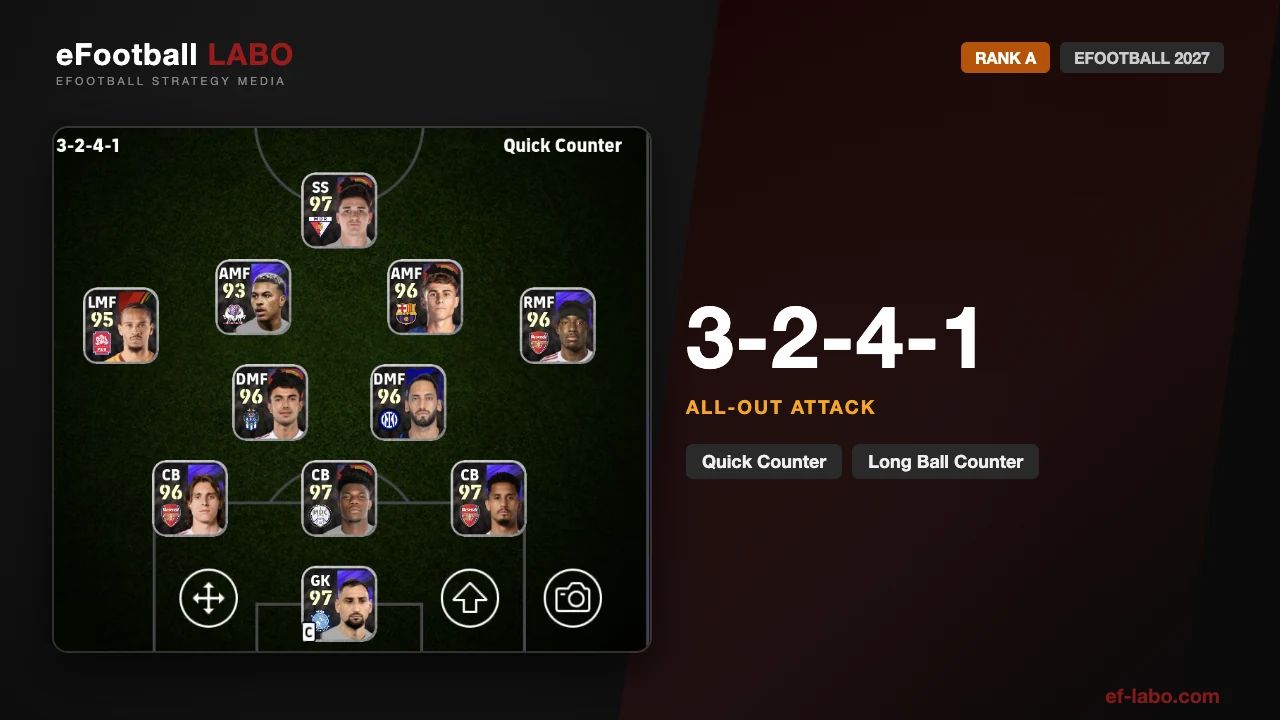
- Rank A — it holds up in Division 1.
- Five forward. You can attack centrally or wide, and you keep the ball high up the pitch.
- Three at the back and no full-backs. Counters down the flanks are the price.
The 3-2-4-1 puts five players in the attack and three at the back. Two wide midfielders, two AMFs and a CF can hurt you through the middle or down either flank, and with that many bodies forward you can keep the ball in their half. What you give up is obvious: three defenders, and a counter down the side takes you apart.
3-2-4-1: overview
| Rank | AWorks in Division 1 |
|---|---|
| In one line | All-out attack — five forward, three at the back |
| Biggest weapon | Attacking centrally and out wide in equal measure, with numbers |
| Biggest weakness | Being countered down the flank, with only three defenders home |
| Suits you if | You want to commit players forward and attack |
| Not for you if | You want to defend first, or keep the ball at the back |
| Team Playstyle | Quick Counter / Long Ball Counter |
Rank A means it works in Division 1. Our ranks come from the Division a formation actually holds up in — this one won four and drew one of five games in Division 1.
What it does well, and where it hurts
- Five players in the attack means the counter arrives with real numbers.
- So many bodies forward that you can keep the ball in their half and go again.
- The wide midfielders and the AMFs let you attack through the middle and out wide with the same players.
- Three at the back with nobody wide of them means a counter down the flank finds space immediately.
- A back three gets pressed and loses it, so you cannot settle the game at the back.
- The game ends up going end to end, and you concede in games you are winning.
The shape
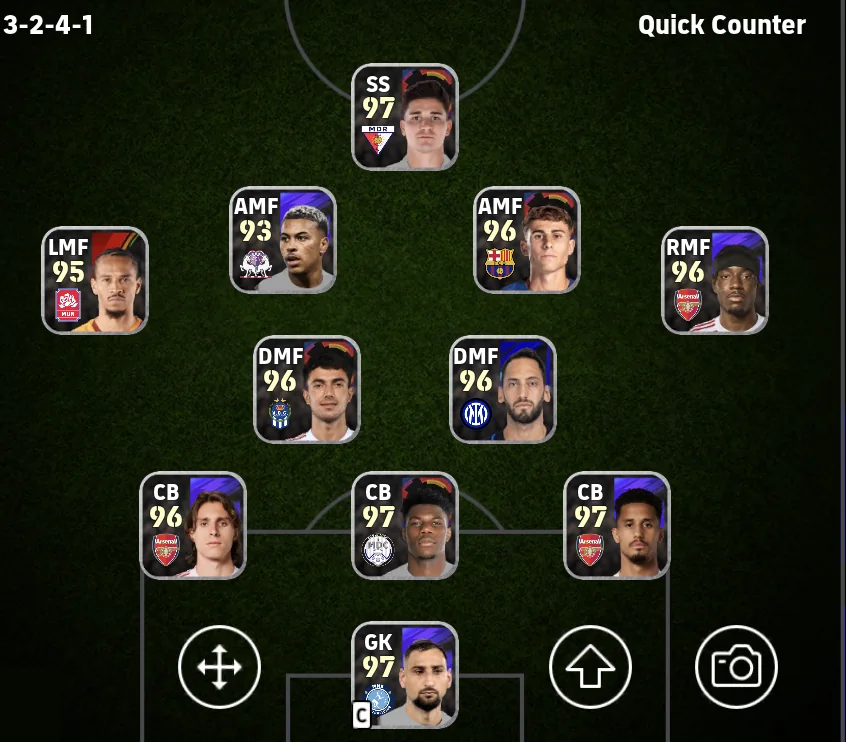
3-2-4-1: three CBs, two DMFs, two wide midfielders with two AMFs, and a CF.
Three CBs, two DMFs in front of them, then a line of four — a wide midfielder on each side with two AMFs between them — and a CF. Three defend and five attack. There are no full-backs, so the wide midfielders are your width going forward and your cover coming back.
How to attack
Five players attack, and they can go through the middle or out wide with the same personnel. Win the ball and the counter already has numbers in it. Against a side that sits in, the two AMFs and the wide midfielders give you enough bodies to keep the ball in their half until something opens.
Quick Counter: win it, and the wide midfielder is already going
Five forward means the counter has bodies in it from the first pass. The run that hurts comes from the wide midfielder, not the CF.
- A DMF cuts out their vertical pass and plays it into the CF
- The RMF breaks forward down the right
- The CF slides the through ball in
- The RMF is one-on-one with the keeper and scores
Through the middle: the CF lays it off and runs
The patient version. One touch from the CF and an AMF who can see the run is all it takes.
- A CB plays it into a DMF
- That DMF plays a vertical pass into the CF
- The CF lays it off first time to an AMF
- As the ball leaves, the CF turns and breaks the line
- That AMF slides it through and the CF finishes
Out Wide: the AMF and the wide midfielder together
The wide midfielder gives it inside, then runs past on the outside. Two players and one exchange opens the flank.
- The RMF gives it inside to an AMF
- The RMF runs beyond that AMF on the outside
- That AMF slides the through ball into the space
- From out there the RMF crosses for the CF
Building up
A back three is not a comfortable place to keep the ball. Three defenders against a press means you get closed down, so do not try to settle the game there. Get it forward, and if the press is on you, use the keeper to make an extra man or go long and start again.
Through the middle: CB to DMF to AMF
Straight up the pitch. The AMF between their lines is the player who turns a slow possession into a fast attack.
- A CB finds a DMF
- That DMF plays it into an AMF who can turn
- That AMF plays a vertical pass into the CF
Mistakes people make, and the fix
They counter down the flank, pull a CB across, and score through the middle
| Why it happens | What to do |
|---|---|
| You lose it in their half, the ball goes wide, and a CB has to come out to meet it. That opens the middle, and their midfielder runs into it. | This is structural — you cannot design it away with five players forward. The fix is the DMF sprinting back to fill that space, every time. Pick CBs who win their duels so the CB going out does not lose it. |
A back three gets pressed and you give it away
| Why it happens | What to do |
|---|---|
| Three defenders against a press has no spare man. Passing it round at the back looks calm until one pass is read. | Do not play risky passes between the CBs. Bring the keeper in to make an extra man, or go long to the CF and rebuild from there. |
How to defend with it
With three at the back and five committed forward, the two DMFs are what holds the game together. Everything below is about how much they cover and how quickly they get back.
| Area | What to do |
|---|---|
| Midfield | Take control of a DMF and cut the pass into their forward. Winning it there is where the counter starts, so this is attacking as much as defending. |
| Wide | On the counter, the outside CBs deal with the flank. When the opposition are keeping the ball, take control of the wide midfielder on that side instead and defend it higher up. |
| Back line | Three at the back is level or short against most counters. Pick CBs who win one-on-ones — with these numbers, that is not a preference, it is a requirement. |
| When ahead | Go to a back five by moving the wide midfielders into full-back positions. You keep everyone on the pitch and the flanks stop being open. |
Players and playing styles that fit
The playing style matters more than the overall rating here. These are the ones the shape actually asks for.
| Position | Playing Style | Why |
|---|---|---|
| CF | Goal Poacher | Runs in behind and finishes. Also the one who lays it off for the AMFs, so a first touch matters. |
| AMFs (both) | Creative Playmaker | Keep the ball moving in their half and get forward themselves. The most important players in the shape. |
| Wide midfielders (both) | Hole Player | Run past the AMFs into the space out wide. They are also the ones who track back, so the legs have to be there. |
| DMF (the passer) | Orchestrator | Takes it off the CBs and finds the AMFs. Passing quality is what gets you up the pitch. |
| DMF (the runner) | Box To Box | Covers the ground the shape leaves open, and sprints back when a CB gets pulled wide. This is the player who keeps you in games. |
| CBs (all three) | Destroyer, and strong in the air | One-on-one defending first. With three at the back and counters coming, you need CBs who simply win the ball. |
Best managers for this formation
3-2-4-1 runs on Quick Counter and Long Ball Counter, so what you want is a manager with high proficiency in those. Every manager below is rank SS on eFootball LABO — high proficiency, a booster and a link-up — picked for their proficiency in these playstyles.
Best managers for Quick Counter





Best managers for Long Ball Counter





Commit the five forward and keep the ball in their half. The DMFs fill the space behind, and the CBs have to win their duels. Go to a back five when you are ahead.
Matchups
| Opponent | Matchup | Why, and what to do |
|---|---|---|
| Sides that sit in a deep block | Good | Five attackers and two AMFs give you the bodies to keep it in their half and work an opening. This is where the shape is comfortable. |
| Sides that attack down the flanks | Poor | The matchup that hurts. No full-backs means a CB comes across and the middle opens. The DMFs have to get back. |
| Sides that press high | Even | A back three has no spare man against a press. Use the keeper, or go long to the CF rather than trying to play through it. |
Matchups are provisional and come from played matches. We update them as we play more.
FAQ
Is 3-2-4-1 good in eFootball?
What Team Playstyle should I use with 3-2-4-1?
What is the weakness of 3-2-4-1?
Why is building up hard with a back three?
What should I do when I am ahead?
Summary
- The spine of it is five in the attack and three at the back. You can go through the middle or out wide with the same players, and the counter arrives with numbers.
- The price is the flanks. There are no full-backs, so a CB comes across and the middle opens behind them — the DMF getting back is the whole defence.
- Do not try to settle the game at the back. A back three under pressure has no spare man. Go to a back five when you are protecting a lead.